
Bloom’s Taxonomy is the foundation of modern learning outcome design. Every Australian VET trainer encounters it in TAE40122 and uses it, formally or informally, every time they write a session plan, design an assessment, or explain why a learner met a unit of competency. This guide covers the full taxonomy, revised version, cognitive levels, verb lists, and practical application in adult training.
Who was Benjamin Bloom?
Benjamin Samuel Bloom (1913-1999) was an American educational psychologist at the University of Chicago. He led the 1956 committee that published the Taxonomy of Educational Objectives, which became the most cited framework in learning design worldwide. He also developed mastery learning and wrote extensively on individual differences in learning.
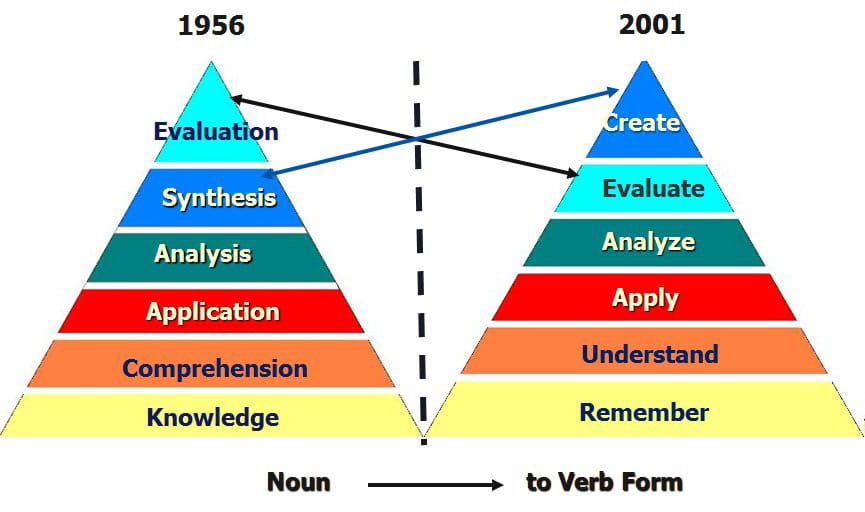
Bloom’s work emerged from a post-war effort to create shared educational assessment standards. Revisions through the 1990s and early 2000s, notably the 2001 Anderson and Krathwohl revision, updated the language from nouns to verbs and expanded the creative level. The current revised taxonomy is the default reference for adult education worldwide.
What is Bloom's Taxonomy?
Bloom’s Taxonomy is a framework for classifying educational objectives into six cognitive levels: Remember, Understand, Apply, Analyse, Evaluate and Create. It was developed in 1956 by Benjamin Bloom and colleagues and revised in 2001 by Anderson, Krathwohl and others. The taxonomy is used to design learning objectives, structure lesson plans, and verify that assessments match the level of thinking required.
Trainers use Bloom’s to write measurable learning outcomes and to ensure their assessments test the right cognitive level. A cognitive level of “Apply” in a unit of competency means the assessment must ask the learner to do the skill, not just describe it. This alignment is central to valid competency-based assessment.
What is Bloom's Revised Taxonomy (2001)?

The 2001 revision changed the taxonomy in two key ways. First, it converted the level names from nouns to verbs (“Knowledge” became “Remember”, “Synthesis” became “Create”). Second, it reordered the top two levels: the original put Synthesis below Evaluation, but the revised version puts Create at the top as the highest cognitive demand.
The revised taxonomy also introduced a second dimension, the Knowledge Dimension, covering Factual, Conceptual, Procedural, and Metacognitive knowledge. This two-dimensional model (cognitive process x knowledge type) gives trainers finer control over learning outcome design. The revised taxonomy is what TAE40122 references throughout the learning design units.
What are the 6 cognitive levels?
- Remember. Recall facts and basic concepts. Learner retrieves relevant knowledge from long-term memory. Verbs: define, list, recall, name, identify, match. Example outcome: “Learner can list the four rules of evidence.”
- Understand. Construct meaning. Learner interprets, exemplifies, classifies, summarises, infers, compares or explains. Verbs: explain, describe, summarise, interpret, paraphrase, classify. Example outcome: “Learner can explain the difference between formative and summative assessment.”
- Apply. Carry out or use a procedure. Learner executes or implements. Verbs: demonstrate, execute, implement, use, carry out, apply. Example outcome: “Learner can apply the principles of assessment to a new assessment tool.”
- Analyse. Break material into parts and detect relationships. Learner differentiates, organises, attributes. Verbs: analyse, compare, contrast, distinguish, examine, investigate. Example outcome: “Learner can analyse an assessment tool for alignment to the performance criteria.”
- Evaluate. Make judgements based on criteria. Learner checks and critiques. Verbs: evaluate, judge, critique, defend, justify, validate. Example outcome: “Learner can evaluate whether the evidence gathered meets the rules of evidence.”
- Create. Combine elements into a new whole or make original work. Learner generates, plans, produces. Verbs: design, develop, construct, produce, formulate, compose. Example outcome: “Learner can design an assessment tool for a unit of competency.”

How do you write learning outcomes with Bloom's?
Strong learning outcomes combine a verb at the right cognitive level with a clear subject and observable condition. The formula most trainers use is: “By the end of [learning], learners will be able to [verb at Bloom level] [specific subject] [condition/standard].”
A well-formed example: “By the end of Session 2, learners will be able to design a competency-based assessment tool that aligns to the performance criteria of a selected unit of competency.” The verb “design” places this at Create (Level 6). The subject is “competency-based assessment tool”. The condition is alignment to performance criteria. The outcome is measurable and assessable.
Common mistakes include vague verbs (“understand”, “know”, “learn”) that cannot be observed, mismatched cognitive levels (listing Remember verbs for a Create-level outcome), and outcomes that describe activities rather than results. Our adult learning principles guide covers complementary design frameworks.
What verbs should you use at each level?
Remember: define, list, label, name, identify, recognise, recall, state, match, memorise.
Understand: explain, describe, summarise, interpret, paraphrase, classify, compare, exemplify, infer, discuss.
Apply: demonstrate, execute, implement, use, apply, carry out, solve, illustrate, operate, sketch.
Analyse: analyse, examine, investigate, differentiate, organise, compare, contrast, distinguish, deconstruct, attribute.
Evaluate: evaluate, judge, critique, defend, justify, validate, rate, assess, appraise, recommend.
Create: design, develop, construct, produce, formulate, compose, generate, plan, invent, devise.
Avoid “understand”, “know”, “appreciate” and other non-observable verbs. These are fine for course overview language but not for measurable learning outcomes.

How does TAE40122 use Bloom's?
TAE40122 uses Bloom’s implicitly throughout the qualification. Units of competency include performance criteria specifying the cognitive level expected. Assessment tools must match. TAEDES411 Use nationally recognised training products to meet vocational training needs covers outcome design. TAEDES412 Design and develop plans for vocational training delivery uses Bloom’s for structuring sessions.
Assessors check alignment between outcome, session activity, and assessment method. If a learning outcome is at Create level (“design a session plan”) but the assessment only asks for Remember level (“list the components of a session plan”), the assessment fails validity. This alignment check is one of the core skills TAE40122 teaches. See our what units are in TAE40122 guide for unit detail.
What are the limitations of Bloom's Taxonomy?
Several critiques exist. First, the hierarchy assumes Create is always harder than Remember, but expert practitioners often create fluently while remembering specific facts is hard. Second, it does not include affective or psychomotor domains (those exist in separate Bloom frameworks). Third, the categories can overlap in practice: evaluating and analysing often happen together.
Modern learning design often combines Bloom’s with frameworks like Webb’s Depth of Knowledge, SOLO Taxonomy, and UDL. TAE40122 introduces Bloom’s as the default reference but encourages trainers to use complementary frameworks for different contexts. Most Australian VET trainers use Bloom’s for 70-80% of design work and specialist frameworks for the rest.
Bloom's for VET assessment design
Every unit of competency specifies performance criteria. These criteria typically include verbs at different Bloom levels. Assessors break each criterion into Bloom levels when designing evidence-gathering methods. A criterion at Apply level should be assessed through demonstration or workplace product. A criterion at Evaluate level should include reflection or peer review tasks.
Practical example: a unit might include the performance criterion “Evaluate the effectiveness of the training session”. The verb is at Bloom’s Evaluate level. The assessment method must include reflection or evaluation activity, not just demonstration. Observation alone is insufficient.
Bloom's cheat sheet for trainers
For a 60-minute training session, aim for a mix of Bloom levels to match adult learning principles and to sustain engagement. A suggested structure:
- Opening (5-10 min): Remember and Understand (recall prior knowledge, explain new concepts).
- Middle (30-40 min): Apply and Analyse (practical activities, case studies).
- Assessment or close (10-15 min): Evaluate and Create (synthesis tasks, peer feedback).
Session planning templates in TAE40122 use this structure. For workshop-length sessions, each hour includes all six levels in mini-cycles. For multi-day courses, each day follows a Remember-to-Create progression.
Related reading
- Anderson, L. W., & Krathwohl, D. R. (Eds.). (2001).
A Taxonomy for Learning, Teaching, and Assessing: A Revision of Bloom’s Taxonomy of Educational Objectives.
Frequently Asked Questions
What's the difference between the 1956 and 2001 Bloom's?
The 2001 revised version converted nouns to verbs and reordered the top two levels (Create is now highest, above Evaluate). It also added a Knowledge Dimension (Factual, Conceptual, Procedural, Metacognitive). The 2001 version is the current reference.
Is Bloom's Taxonomy still used?
Yes, worldwide. It is the default reference framework in most adult education curriculum standards, including Australian VET and AQF alignment work.
Is Bloom's a learning theory?
No. Bloom’s is a classification framework for cognitive objectives, not a theory of how learning happens. For learning theories see andragogy (Knowles), experiential learning (Kolb), and constructivism.
Can Bloom's be used for competency-based assessment?
Yes. The verb at each performance criterion indicates the cognitive level, which drives the method of evidence gathering. This is central to assessment tool design in TAE40122.
Why do some trainers dislike Bloom's?
Main critiques are that the hierarchy is rigid and that it overlooks affective and psychomotor domains. Supplementing Bloom’s with other frameworks resolves most concerns.
Learn TAE (delivered in partnership with RTO 40407) teaches Bloom’s applied to real assessment design through TAEDES411, TAEDES412 and TAEASS412. Learners leave able to align every outcome, session and assessment to a specific cognitive level. Check the next cohort at https://learntae.com.au/tae40122-course-overview/
Need more information?
Call our friendly support staff on 1300 858 849.