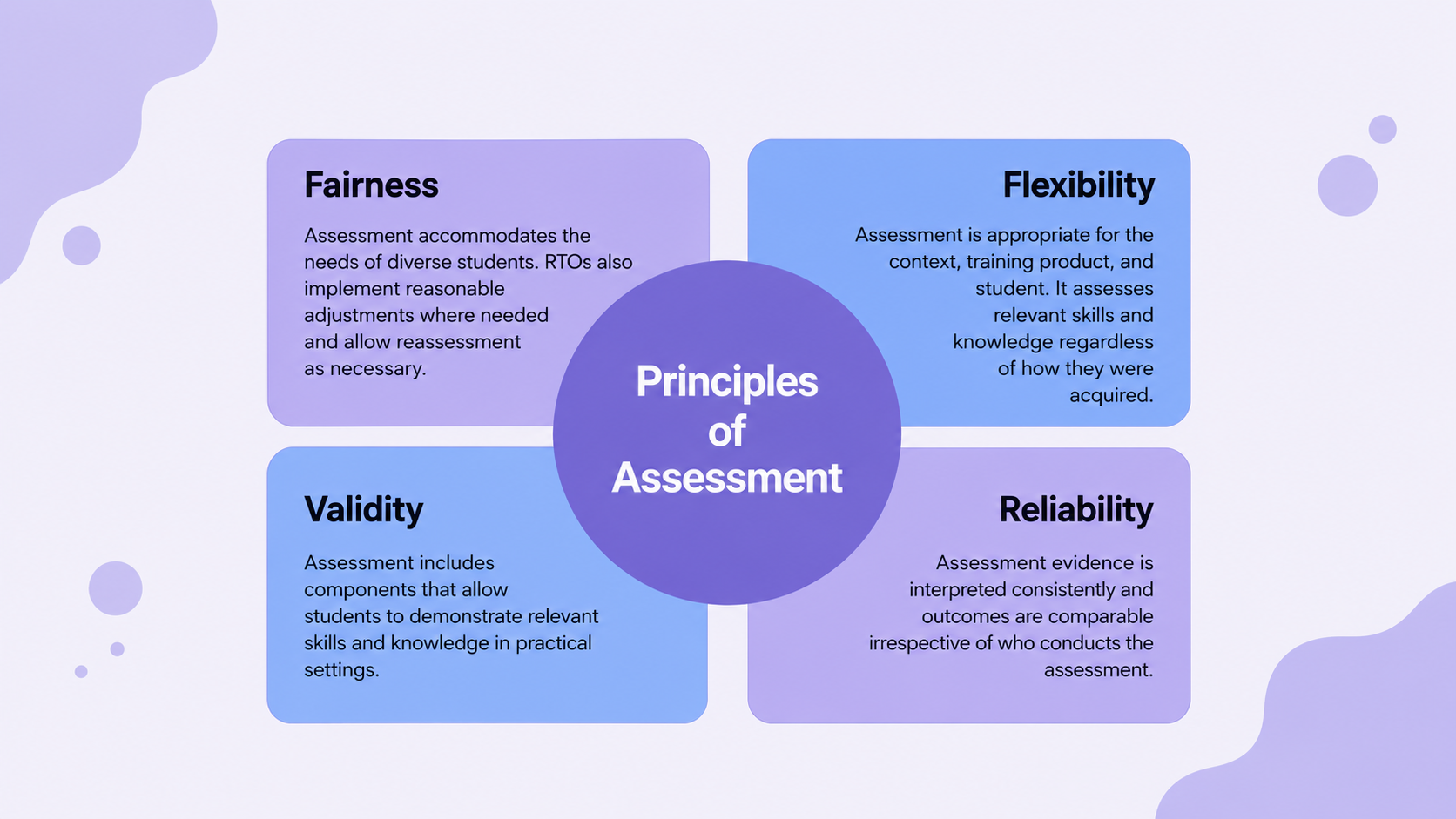
The four principles of assessment are the foundation of every compliant VET assessment in Australia. They are named in the Standards for RTOs 2025 and applied to every assessment tool, every judgement and every validation. This guide walks through each principle in plain English with three examples for each, plus guidance on how to apply them together.
What are the 4 principles of assessment?
The four principles of assessment are validity, reliability, fairness and flexibility. They apply to every assessment in Australian VET and are enshrined in the Standards for RTOs 2025. Validity means the assessment measures the actual competency. Reliability means different assessors reach the same judgement. Fairness means no learner is disadvantaged by factors unrelated to the competency. Flexibility means assessment accommodates individual circumstances.
Every assessment tool and every assessor judgement in Australia must demonstrably meet all four principles. The four principles work alongside the four rules of evidence (sufficient, valid, authentic, current) to create the compliance framework. See our competency-based assessment guide for the broader framework.
Validity explained
Validity means the assessment tool actually measures the competency specified in the unit. An assessment is valid when the tasks, evidence requirements and performance criteria align to the unit of competency’s performance criteria and performance evidence. Validity is the central principle. If an assessment lacks validity, the other principles cannot save it.
A validity problem typically looks like one of these: the assessment asks theory questions when the unit requires practical demonstration, the assessment tests easier-adjacent skills instead of the actual competency, or the assessment ignores parts of the unit. Every TAE40122 assessment tool includes a mapping document that shows exactly which task addresses which performance criterion. This mapping is what auditors check first.
Reliability explained

Reliability means different assessors reach the same judgement on the same evidence. A reliable assessment produces consistent decisions regardless of who applies it. Reliability requires clear marking guides, moderation, validation, and shared understanding across the assessment team.
Reliability is the hardest principle to engineer at scale. Every RTO has some variation between assessors. The goal is to minimise it through clear criteria, worked examples, assessor calibration sessions and ongoing validation. Without reliability, two learners with equivalent evidence could receive different judgements, which is both unfair and non-compliant.
An assessment tool includes a rubric with 5 specific criteria and 3-level ratings — met, partially met and not met. Multiple assessors applying the rubric reach the same judgement 90%+ of the time.
An assessment has no rubric and asks assessors to use their "professional judgement".
Three different assessors reach three different conclusions on the same evidence.
An RTO runs a calibration session where four assessors each mark the same sample portfolio, compare notes and discuss differences.
After calibration, their judgements align within 85%. The RTO repeats the calibration process quarterly.
Fairness explained
Fairness means no learner is disadvantaged by factors unrelated to the competency being assessed. Fairness covers accessible language, cultural appropriateness, disability accommodation, LLN support, and transparent processes. It also requires that learners receive clear information about what will be assessed, how, and what evidence is required.
Fairness is closely linked to the Australian Human Rights Act 1986 and the Disability Discrimination Act 1992. A fair assessment treats every learner with equal opportunity to demonstrate competency, using reasonable adjustments where needed.
The assessment requires written responses only. A learner with dyslexia requests oral questioning as a reasonable adjustment.
Flexibility explained
Flexibility means assessment accommodates individual learner circumstances without lowering the competency standard. Flexibility includes reasonable adjustments, multiple evidence pathways, timing flexibility, location flexibility, and format variations. Flexibility supports fairness by letting each learner demonstrate competency in the way that suits them.
Flexibility is also a sensible principle for RTO efficiency. Rigid assessment designs fail learners who could demonstrate competency differently. Flexible designs match how VET is actually delivered in workplaces. The limit is the competency standard: flexibility never lowers the criterion.
A learner cannot attend the planned assessment date due to illness.
A learner has 15 years of industry practice and requests RPL for several units.
A learner with a physical limitation cannot demonstrate a physical task but can demonstrate the underlying competency through simulation, planning and theory.

How do you apply all four together?
The four principles work together rather than in sequence. A strong assessment design starts by asking four questions:
Validity question: Does this task actually measure the competency specified in the unit?
Reliability question: Would another assessor reach the same judgement on this evidence?
Fairness question: Does this disadvantage any learner for reasons unrelated to the competency?
Flexibility question: Can learners demonstrate this through more than one reasonable pathway?
TAE40122 unit TAEASS412 Assess competence teaches this four-question discipline alongside TAEASS413 Participate in assessment validation. Learners practise it on real assessment tool design and validation activities. Our TAE40122 units guide has more detail on the assessment units.
Rigid rubrics can produce consistent judgements while failing to actually measure the competency.
Flexibility changes the pathway, not the standard. Accepting partial evidence for a Competent judgement is not flexibility; it is a breach of validity.
Standard-format assessments may work for most learners while disadvantaging specific groups.
Validation must include both tool review and a sample of actual judgements. Tool-only validation can miss reliability issues.
Principles of assessment require ongoing attention, not a single check-off.
What does ASQA focus on?
ASQA audits look at whether assessment tools demonstrably meet the principles through documented evidence. Common findings include tools that do not map to all performance criteria (validity), assessor judgements that lack supporting evidence (reliability), language barriers in assessments (fairness), and rigid one-pathway assessments (flexibility).
For learners and trainers, the takeaway is that every assessment interaction documents how the four principles were applied. A simple habit: each assessment decision gets a short note confirming “valid mapping, reliable judgement, fair process, flexible where required”. That practice protects the RTO and the trainer.
Related reading
Federal Department of Education – Disability Standards for Education 2005
Federal Register of Legislation – Australian Human Rights Commission Act 1986
Learn TAE – What Units Are in TAE40122? Full Unit-by-Unit Breakdown
ASQA – Standards for RTOs
Frequently Asked Questions
What's the difference between principles and rules?
Principles of assessment apply to the assessment design and process (how you assess). Rules of evidence apply to the evidence gathered (what you collect). Both must be met for compliant assessment.
Is one principle more important?
Validity is typically called the most important because the other three cannot compensate for a non-valid assessment. But all four must be met for compliance.
Can you have validity without reliability?
Technically yes, but in practice they are linked. A valid-but-unreliable assessment produces inconsistent results, which undermines the validity claim.
Do the principles apply to RPL?
Yes. Every RPL assessment must meet all four principles. RPL specifically relies on flexibility while maintaining validity.
What if I fail to meet a principle?
The assessment is non-compliant. You redesign the tool, repeat the validation, and re-assess learners if their judgements depended on a non-compliant tool.
Master the four principles in TAE40122 at Learn TAE
Learn TAE (delivered in partnership with RTO 40407) teaches assessment design including the four principles through TAEASS412 and TAEASS413. You leave able to design compliant tools, defend your judgements, and participate in validation. Check the next cohort at https://learntae.com.au/tae40122-course-overview/
Need more information?
Call our friendly team on: 1300 858 849