How hard is Cert IV in Training and Assessment; Most prospective learners ask the same question before enrolling in TAE40122: how hard is it really? You will find answers ranging from “a few weekends of light reading” to “overwhelming and brutal”. Reality sits in the middle. This guide gives you an honest assessment based on how learners actually experience the qualification.
How hard is Cert IV in Training and Assessment?
TAE40122 is moderately difficult for most adult learners. It requires a meaningful time commitment across 12 units (6 core and 6 electives), including facilitation practice and assessment design. Learners with vocational expertise but limited formal study experience typically find the writing and compliance documentation the hardest parts. Learners from academic backgrounds often find the practical delivery components more confronting. No single component is technically advanced. The challenge is breadth, consistency, and evidence discipline across 12 interrelated units.
Learn TAE markets a 100% success rate across our delivery modes, and most who struggle do so because of time management or unclear evidence rather than lack of ability. The qualification sits at AQF Level 4, equivalent to a skilled trade or para-professional credential. It is not a degree-level difficulty. It is also not a casual credential you can complete over a weekend.
What actually makes TAE40122 challenging
Volume of units. Twelve units, each with performance criteria, evidence requirements, and assessment tasks. Even if each unit is manageable alone, twelve in sequence creates real cognitive load.
Evidence discipline. VET assessment requires specific, sufficient, authentic, and current evidence. Most first-time learners underestimate how precisely evidence must map to competency criteria.
Live training delivery. You must design, deliver, and reflect on real training sessions in front of adult learners. Nerves aside, the preparation is substantial.
Assessment design. You must build assessment tools that meet the principles of assessment and rules of evidence. This is where academically inclined learners thrive and practical trainers often hit friction.
Foundation skills integration. TAELLN422 (Use foundation skills resources, strategies and advice) requires you to identify language, literacy, and numeracy needs in real learners and respond appropriately, not bolt it on at the end.
VET sector context. TAEPDD401 (Work effectively in the VET sector) is the new core unit in TAE40122. It introduces compliance, ethics, and professional practice in a way that feels bureaucratic to people from non-RTO backgrounds.
Portfolio assembly. Bringing 12 units of evidence into a clean, navigable portfolio takes organisation.
What Does Not Make Cert IV in Training and Assessment Difficult
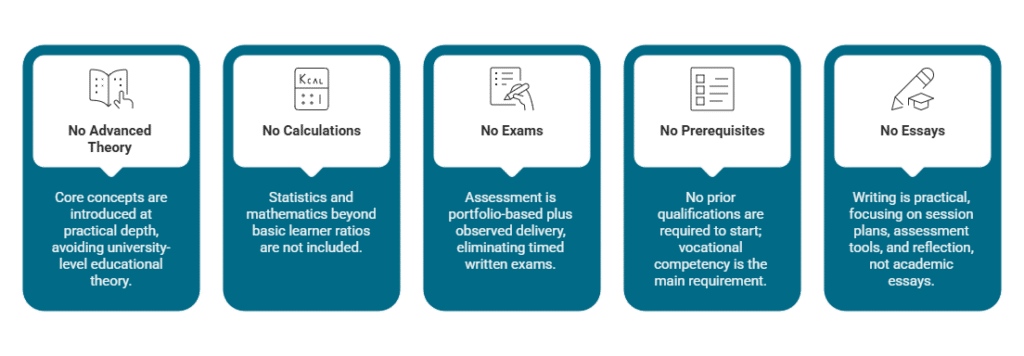
No advanced theory. You will not encounter university-level educational theory. Core concepts are introduced at practical depth.
No calculations. No statistics, no maths beyond basic learner ratios.
No exams. Assessment is portfolio-based plus observed delivery. No timed written exams.
No prerequisites. No prior qualifications required to start. Vocational competency in your field is the main requirement.
No essays. Writing is practical (session plans, assessment tools, reflection), not academic essays.
Who Typically Struggles With Cert IV in Training and Assessment?
People short on time. Attempting TAE40122 with under 5 to 7 hours per week available is tough. Choose a delivery mode that matches your time budget.
People resistant to documentation. Hands-on trainers often resent paperwork. TAE40122 requires a lot of it. Attitude matters.
People avoiding technology. Digital portfolios, virtual classrooms, document formatting. Basic digital literacy is assumed.
People without current workplace access. You need access to learners for live sessions. Enterprise trainers have this naturally. Career changers may need to arrange it.
People with long-expired study habits. If you have not studied formally in 20+ years, the first couple of units may feel slow. It rebuilds quickly.
Perfectionists. Over-polishing every assessment delays completion. Good enough to demonstrate competency is the target, not a polished essay.
Who Typically Succeeds in TAE40122
Current enterprise trainers. Day-job workplace access, existing training experience, familiar with vocational competency assessment.
Career changers with time. Dedicated study time, motivated, unfamiliar with VET but open to learning.
Tradies with workplace learners. Apprentices or junior team members to practise with. Clear vocational expertise to draw from.
Fitness and allied health trainers. Strong delivery skills. Existing client rapport transfers naturally to a trainer context.
Former teachers or academics. Writing and documentation come easily. Practical delivery units take more focus.
The harder parts of TAE40122 at Learn TAE

TAEPDD401 Work effectively in the VET sector. The new core unit. Sits inside Cluster 1 (VET Launchpad). Conceptually unfamiliar to anyone who has never worked inside an RTO context, so it usually takes time to absorb.
TAEDES412 Design and develop plans for vocational training. Session plans, learning outcome alignment, sequencing. Front-end work that affects everything downstream.
TAEASS412 + TAEASS413 (Assess competence + Participate in assessment validation). These sit at the heart of Cluster 2 (Design2Deliver). Once you understand assessment principles and rules of evidence, the rest of the qualification gets easier. Until then, this is where most rework happens.
TAELLN422 Use foundation skills resources, strategies and advice. Requires you to identify foundation skill gaps in actual learners and respond. Abstract for people without diverse learner exposure.
The Easier TAE40122 Units
TAEDEL411 Facilitate vocational training. Delivery is often natural for trainers with prior experience.
TAEDEL412 Facilitate workplace based training. Practical application of what experienced workplace trainers already do.
TAEDEL311 Provide work instruction. Lower AQF level, structured around showing someone how to do something. Often the most familiar territory.
TAE40122 Workload: How Effort Distributes Across the Qualification
For most learners, effort splits roughly across these activities:
- Reading and preparation: materials review and content learning
- Session and program design: building session plans and learning programs
- Live training delivery: planning, delivering, and reflecting on sessions
- Assessment tool design: building assessments that meet rules of evidence
- Portfolio assembly: evidence organisation, referencing, formatting
- Reflection and iteration: feedback responses and revisions
The single biggest variable is your starting point. Existing trainers move through delivery faster. Career changers move through documentation slower. Both finish.
Realistic TAE40122 Completion Timelines by Delivery Mode
Face-to-Face Streamlined at Cannon Hill. Four weeks of structured delivery with assessment integrated throughout the workshop. Most assessment requirements are completed during the four-week block, with post-completion support for any final evidence. See the face-to-face delivery page.
Virtual Online Classroom. A three-phase structure: Phase 1 self-paced foundation learning, Phase 2 live virtual workshops across a four-week structure (Weeks 1 and 2 cover Foundation and Assessment Mastery, Weeks 3 and 4 cover Delivery and Leadership Excellence), Phase 3 ongoing support of up to six months for practical assessments and workplace projects. Response time on email and virtual support sits at within 24 hours. See the virtual online page.
Self-Paced. Up to 12 months to complete, at $749 per cluster (four clusters total) or $350 per unit (12 units total). Best for people who want to space the work around full-time work. See the self-paced page.
Trainer Mentoring Program. Adds career planning, business development coaching, and ongoing mentoring on top of TAE40122 delivery. Contact for pricing. See the Trainer Mentoring Program page.
A $99 non-refundable enrolment fee applies across all modes.
What Learners Say After Completing TAE40122

“Harder than I expected, easier than I feared.”
“The writing was tougher than the delivery.”
“I wish I had given it more time per week rather than trying to cram.”
“Once I had my first session done, confidence built fast.”
Consistent themes: pace yourself, take assessment seriously, and the delivery units build confidence quickly.
Tips for Success in TAE40122
Block consistent study time. 5 to 8 hours per week works better than 12 hours one week and zero the next.
Ask questions early. Confusion compounds. Use the support channels in your delivery mode rather than guessing.
Use templates provided. Session plan, assessment tool, and validation templates save hours. Customise rather than rebuild from scratch.
Record your sessions. Video your live training sessions (with consent). Reviewing yourself improves the written reflection enormously.
Map evidence as you go. Don’t leave portfolio assembly to the end. Tag evidence to units as you complete each piece.
Don’t over-write. Respond to the assessment criteria. More words don’t help. Clear, specific, competent response does.
Leverage peers. Cohort discussions, peer reviews, practice session audiences. Training is a social skill.
Frequently Asked Questions
Is TAE40122 harder than TAE40116?
Slightly. The new core unit TAEPDD401 (Work effectively in the VET sector) and the foundation skills unit TAELLN422 add scope. Overall difficulty is similar.
Can I fail?
You can receive “not yet competent” on individual assessments and rework them. Outright failure is rare because Learn TAE works with you to reach competency.
What if I have no teaching experience?
Most TAE40122 learners don’t. The qualification teaches you. Vocational expertise in your field matters more than prior teaching.
How much does experience matter?
Trade or vocational experience helps with credibility and confidence. It doesn’t replace the qualification learning.
Can I do it without strong computer skills?
Basic digital literacy (Word, email, video conferencing) is required. You don’t need advanced tech.
Is it harder than a degree?
No. AQF Level 4 sits well below bachelor degree level. Academically lighter, but practically demanding.
Can I work full-time while doing it?
Yes. The Virtual Online Classroom and Self-Paced modes accommodate working schedules.
What is Learn TAE's success rate?
Learn TAE markets a 100% success rate across delivery modes. The combination of small group sizes, integrated assessment, and ongoing trainer support is designed to keep learners on track to competency.
Ready to start?
Learn TAE (RTO #40407) runs TAE40122 across four delivery modes (Face-to-Face Streamlined, Virtual Online Classroom, Self-Paced, and the Trainer Mentoring Program) so you can match the qualification to your situation. Talk to an advisor about which mode suits you. Call 0459 021 011 or visit our course overview page to learn more!